
JPEG 2000: The Better Format That Lost, and Where It Still Lives
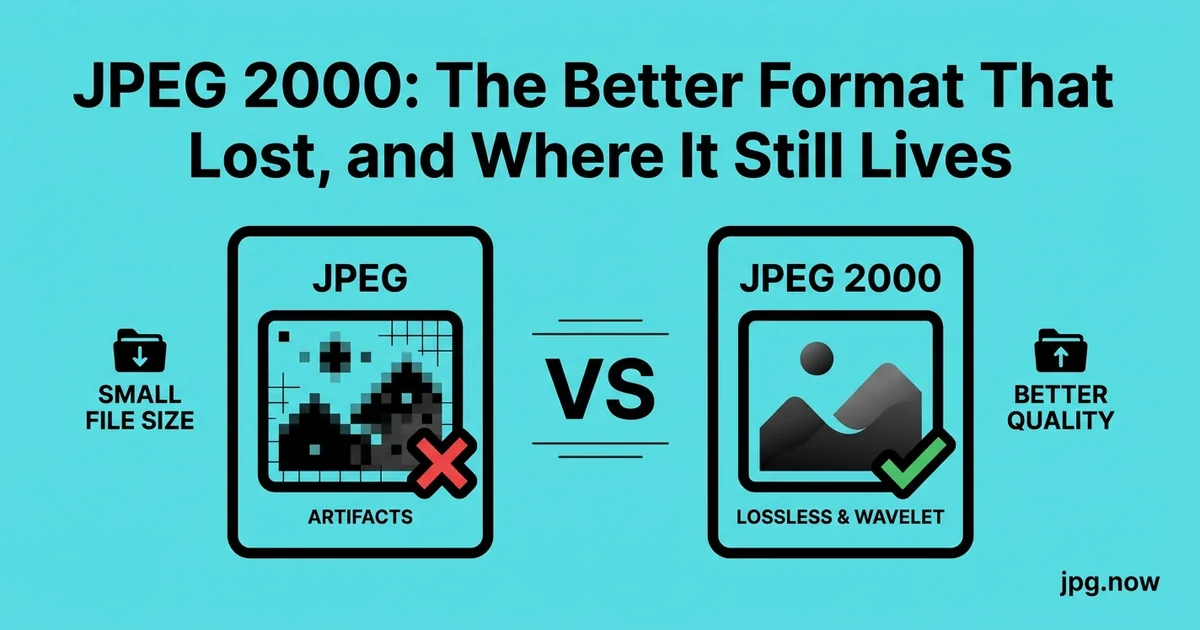
In 2000, a committee of the world's smartest image compression engineers published JPEG 2000 and confidently expected it to replace baseline JPEG within a decade. The new format had wavelets instead of DCT, true lossless modes, 16-bit color depth, progressive decoding by quality, and visibly better image quality at low bitrates. By 2026, baseline JPEG still owns roughly 75 percent of the images on the open web. JPEG 2000 is alive and well, but only inside cinema servers, hospital archives, satellite imagery pipelines, and museum digital collections. This is the story of how an objectively better format lost the consumer format war.
The lesson here is not "good engineering does not matter." It is "good engineering is necessary but not sufficient; deployment, decoder economics, and just enough patent fog will decide format wars regardless of technical superiority." Reading this case carefully will save you from making the same prediction error about every future codec, including ones you are personally betting on right now.
Background: what JPEG 2000 actually delivered
The JPEG 2000 committee finished the Part 1 standard in December 2000 after roughly four years of work. The format used the discrete wavelet transform (CDF 9/7 for lossy, CDF 5/3 for lossless) instead of the 8x8 DCT in baseline JPEG. It supported up to 16,384 components per image (vs JPEG's 4), arbitrary bit depths from 1 to 38 bits, both lossy and lossless modes in the same file, progressive transmission by resolution or by quality, region-of-interest encoding, and tile-based access for huge images. Everything baseline JPEG could not do, JPEG 2000 could.
The technical wins are real
JPEG 2000 uses the discrete wavelet transform instead of the 8x8 DCT in baseline JPEG. At quality settings below about 0.5 bits per pixel, JPEG 2000 produces visibly cleaner images: no blocky 8x8 artifacts, smoother gradients, and better preservation of fine detail. The format supports both lossy and fully lossless modes in the same file, progressive decoding by quality or resolution, alpha channels, arbitrary bit depths, and tile-based access for huge images. Our compare tool can flip side-by-side between a baseline JPEG and a JPEG 2000 of the same source.
Step-by-step: what killed it on the web
- Patent uncertainty from 2000-2007. Forgent Networks and other claimants threatened JPEG 2000 licensing terms. Browser vendors stayed away.
- Decoder CPU cost on 2000s hardware. Wavelet decode ran 3-5x slower than DCT decode on Pentium III and early Pentium IV chips, which mattered enormously for the slow connections of the era.
- Small file-size win at typical web quality. At 0.75 bpp (typical for web photos), JPEG 2000 saved only 15-25 percent over baseline JPEG, not enough to justify deployment.
- Browser vendor inertia. Internet Explorer never shipped support. Firefox declined. Chrome did not exist until 2008. By the time it could have, AVIF and WebP were on the horizon.
- Camera makers passed. Canon, Nikon, Sony all kept baseline JPEG. Without consumer device support, web-delivery support did not matter.
- Lossy artifacts at very high compression looked "weird." Wavelet ringing artifacts at low bitrates were unfamiliar; viewers preferred the familiar blockiness of JPEG.
- The deployment Catch-22. Encoders need decoders to be useful; decoders need encoded content to be worth shipping. Without a champion, the network effect never started.
So what killed it on the web?
Three problems together. First, the patent situation in the early 2000s was messy enough that browser vendors stayed away even after the core patents were cleared. Internet Explorer never shipped support, Firefox never shipped support, and Chrome did not exist yet. Second, the decoder was slow on early-2000s hardware: wavelet transforms cost three to five times the CPU of baseline JPEG decoding. Third, the file-size win at typical web quality (around 0.75 bits per pixel) was only 15 to 25 percent over baseline JPEG, not enough to justify replacing an installed base in the billions.
Camera makers passed
Canon, Nikon, and Sony all evaluated JPEG 2000 in the early 2000s and chose to keep baseline JPEG plus their proprietary RAW formats like CR2, NEF, and ARW. The reasoning was simple: baseline JPEG decoded fast enough on the embedded ARM chips inside cameras to enable burst shooting, while wavelet decode was a real CPU cost. Once the camera makers stayed out, the format had no consumer momentum.
Where it survived: digital cinema
The Digital Cinema Initiative chose JPEG 2000 as the mandatory image codec for the DCP (Digital Cinema Package) format in 2004. Every movie you have seen in a multiplex projected from a digital server since then has been stored as JPEG 2000 frames at up to 250 megabits per second. The reasons were tile-based access, lossless intra-frame compression, and the ability to handle 4K and 8K cleanly. JPEG 2000 in cinema is a $30 billion industry's unsung infrastructure.
Where it survived: medical imaging
DICOM, the medical imaging standard, supports JPEG 2000 as one of its transfer syntaxes. Radiology PACS systems store CT and MRI series in lossless JPEG 2000 because the lossless mode actually compresses better than PNG on the kind of high-bit-depth grayscale that medical scans produce, and progressive-by-quality decoding lets a radiologist start interpreting a study before the full high-resolution data arrives.
Where it survived: archival and library digitization
The Library of Congress, the British Library, and most major national archives use JPEG 2000 for their digitization masters. The combination of lossless storage, scalable quality previews, and a single file format that supports arbitrary resolution made it the right answer for collections measured in petabytes. When you browse a high-resolution scan of a historical document on a national archive website, you are looking at a JPEG 2000 served through an IIIF tile server.
Where it survived: aerial and satellite imagery
Satellite and aerial imagery providers like Maxar and Airbus store the source mosaics as JPEG 2000 because the tile-based access pattern matches the way GIS clients request small windows of a much larger image. Loading a 100,000-by-100,000-pixel scene at a usable speed depends on a codec that supports random tile access, and JPEG 2000 has done that since 2000.
Comparison: JPEG 2000 vs the modern alternatives
| Format | Year | Browser support 2026 | Compression win vs JPEG | Niche |
|---|---|---|---|---|
| Baseline JPEG | 1992 | Universal | baseline | Everyday photos |
| JPEG 2000 | 2000 | Safari only | 15-25% (lossy) | Cinema, medicine, archive |
| WebP | 2010 | Universal | 25-35% | Web delivery |
| AVIF | 2019 | ~95% | 40-50% | Web delivery (modern) |
| JPEG XL | 2021 | Firefox, Safari | 20-30% (lossy) or 20% smaller lossless from JPEG | Future-facing |
Common mistakes (and how to fix them)
- Mistake: assuming JPEG 2000 works in browsers. Only Safari has native support. Fix: use baseline JPEG or WebP for the web; reserve JPEG 2000 for backend storage only.
- Mistake: choosing JPEG 2000 for new archival projects without considering JPEG XL. Fix: benchmark both for your content; JPEG XL often wins on storage while remaining easier to decode.
- Mistake: shipping a .jp2 file in an email expecting the recipient to open it. Fix: convert to baseline JPEG or PDF before sending.
- Mistake: confusing JPEG 2000 with baseline JPEG plus more quality. Fix: they are different codecs; quality and file structure differ substantially.
- Mistake: storing lossy JPEG 2000 thinking it is lossless. Fix: confirm the encoding mode (lossless uses CDF 5/3 reversible transform; lossy uses 9/7).
- Mistake: relying on outdated decoders. Fix: use OpenJPEG 2.5+ which fixed many older buffer-overflow vulnerabilities.
Real-world examples
British Library Endangered Archives. Manuscript digitization stored as lossless JPEG 2000 at 600 DPI, with IIIF tile-server delivery to scholars worldwide. Some collections exceed 1 PB.
Mayo Clinic radiology. CT and MRI series in DICOM-wrapped lossless JPEG 2000. Progressive-by-quality streaming lets remote radiologists start interpreting before the full study has downloaded.
IMAX cinema chain. Every digital cinema package mastered for IMAX projection ships as JPEG 2000 frames at up to 250 Mbps, played back from spinning-disk RAID arrays in projection booths worldwide.
The format that actually replaced JPEG
If JPEG 2000 had a successor for the open web, it is the combination of WebP and AVIF. WebP arrived in 2010 and reached browser ubiquity around 2020. AVIF arrived in 2019 and reached usable browser support around 2022. Both deliver a meaningful file-size win over baseline JPEG and decode acceptably on consumer hardware. They are not based on wavelets, but they finally accomplished what JPEG 2000 set out to do: smaller files at equivalent quality.
Should you use JPEG 2000 today?
For an open-web product photo or blog hero image, no. Use baseline JPEG or WebP. For an archival master of a scan, yes, JPEG 2000 lossless is still the right answer alongside TIFF. For medical imaging, use whatever your PACS speaks, which is probably JPEG 2000. For everything else, JPEG 2000 is a beautiful piece of engineering you will not encounter in your daily workflow.
The IIIF connection
If you use the International Image Interoperability Framework to serve high-resolution images on the web (museums, universities, and archives all do), the source images on the back end are almost always JPEG 2000. The IIIF Image API expects a tile-based source so a viewer can request a 256x256 pixel slice at zoom level 5 without decoding the entire 50,000-pixel master. JPEG 2000 is the only widely deployed format that handles this access pattern natively, which is why it remains foundational to museum and library digital infrastructure even though almost no end user ever sees a .jp2 file.
Advanced tips
- Use OpenJPEG 2.5+ for encoding. Faster, more secure, better tooling than older versions.
- Choose tile size deliberately. 512x512 or 1024x1024 tiles balance random-access speed against compression efficiency.
- Configure quality layers for progressive delivery. Five quality layers lets you serve a fast preview and a full-quality final without storing multiple files.
- Use lossless (CDF 5/3) for archive masters. Lossy (CDF 9/7) only for delivery copies.
- Pair with IIIF Image API for delivery. Backed by JPEG 2000, served as JPG/WebP to browsers via on-the-fly transcoding.
- Inspect with `opj_dump`. Tells you compression mode, layer structure, and tile organization.
- Migrate to JPEG XL for future-proofing. If your archive is small enough to re-encode, JPEG XL gives broader future tool support.
FAQ
Why does Safari support JPEG 2000 but not other browsers?
Apple shipped JPEG 2000 in macOS and iOS image frameworks early and never removed it. Chrome and Firefox declined because of patent uncertainty and the cost-benefit math at the time.
Is JPEG 2000 patent-free now?
Yes, the core JPEG 2000 Part 1 patents have expired. The ecosystem remains small because the momentum never built.
Can I view a .jp2 file on Windows?
Not natively. Install IrfanView or open in GIMP. Or convert to JPG with our image converter first.
Is JPEG 2000 better than AVIF?
For lossless and archival, yes. For modern web delivery, AVIF wins on file size, browser support, and decoder performance.
Does JPEG 2000 work for HDR content?
Yes, it supports up to 38-bit per component. In practice, modern HDR delivery uses AVIF or JPEG XL.
Why do cinemas use JPEG 2000 instead of H.264?
Intra-frame coding means every frame is independent, no GOP structure. Easier to seek, edit, and project frame-by-frame. H.264's inter-frame compression is great for streaming, wrong for theatrical playback.
What is the relationship between JPEG 2000 and DICOM?
DICOM is the medical imaging file container; JPEG 2000 is one of the image-data encodings DICOM supports. Most modern PACS systems use lossless JPEG 2000 inside DICOM for storage.
Cinema-specific reasons JPEG 2000 stuck
The digital cinema use case is worth understanding because it shows where JPEG 2000's design pays off. Cinema needs frame-accurate seeking (intra-frame only, no GOP structure), lossless intra-frame storage for color-graded masters, high bit depths (12-bit per channel), and high resolutions (4K, 6K, soon 8K). Video codecs like H.264 and H.265 use inter-frame prediction for compression efficiency, which is great for streaming but terrible for editing and projection seek. JPEG 2000's per-frame independence and high-bit-depth support map exactly to cinema's needs, which is why the Digital Cinema Initiative chose it in 2004 and has not revisited the choice.
Why medical chose it and stayed
Medical imaging similarly needs high bit depths (CT and MRI produce 12-bit or 16-bit grayscale), lossless storage (clinical findings cannot tolerate compression artifacts), and progressive transmission for slow hospital networks. JPEG 2000 ticks all three boxes. The DICOM standard added JPEG 2000 as a transfer syntax in 2003, and the install base across PACS vendors solidified by 2010. Replacing it would require coordinating an entire industry to migrate to JPEG XL or another lossless format; the cost vastly exceeds the benefit, so it stays.
Lessons for codec adopters today
Three lessons from JPEG 2000's failure apply to every emerging codec discussion. First, the deployment cost of new encoders/decoders across the entire device fleet is the dominant constraint, not the codec's technical merit. Second, network-effect-driven formats need a major platform (Google for WebP, Apple for HEIC) willing to ship at scale, not just a working group's blessing. Third, even royalty-free is not enough; you need royalty-free plus a large existing decoder install base before the format becomes a default.
Apply these lessons to JPEG XL, AVIF, and any future codec. AVIF has Google's web platform team behind it, which is why it gained traction faster than JPEG XL despite arriving later. JPEG XL is royalty-free and technically superior to AVIF on lossless re-encoding, but Chrome's hesitation has stalled its adoption. Whichever codec gets the major-platform endorsement first wins, regardless of the engineering merits.
Where to inspect JPEG 2000 files
If you encounter a `.jp2` or `.jpx` file in the wild, tools that open it include: macOS Preview, Safari, GIMP with the `libopenjp2` plugin, ImageMagick, IrfanView, and command-line `opj_decompress`. Most consumer Windows photo apps fail silently. Convert to baseline JPEG with our image converter if you need to share it broadly.
The institutional knowledge problem
One overlooked aspect of niche codecs is institutional knowledge. The engineers who set up a national archive's JPEG 2000 pipeline in 2008 may have retired. The successors inherit a system they did not design and may not fully understand. This is one reason archival institutions are slowly migrating toward TIFF (better documented, broader tool support) for new acquisitions even when JPEG 2000 would compress better. Documentation and successor planning matter more than codec efficiency at institutional scale.
Wrapping up
JPEG 2000 lost because the file-size win at web quality was too small, the decoder was too slow on early-2000s hardware, and the patent fog kept browser vendors away just long enough for the moment to pass. It survives in the places where its specific wins matter: cinema, medicine, archives, satellites. Run a real comparison on your own image with our image info, JPG compressor, and the rest of the tools to see why baseline still works for most jobs.
The next time someone claims a new image codec will replace JPEG in five years, remember 2000. Technical superiority is the entry ticket, not the win condition. Watch for deployment momentum, browser engineering investment, and encoder availability before you commit. And for daily work, our JPG compressor, converter, and JPG to WebP path are still the safe bets.