
How Photographers and Designers Can Map Out a Full Shoot Year
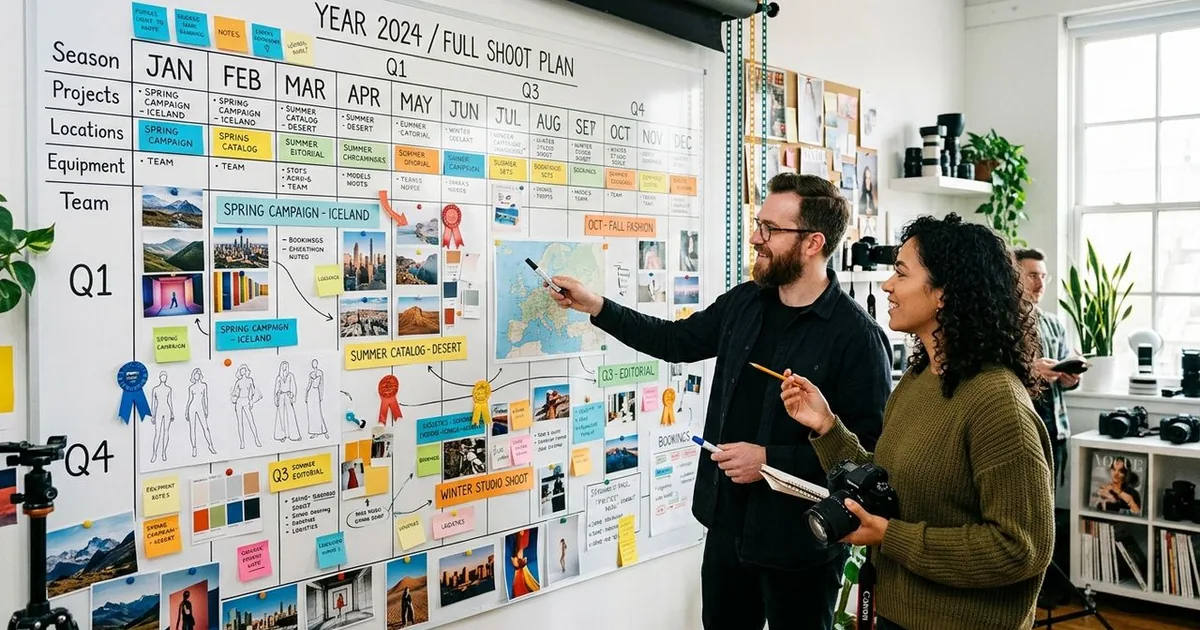
Running a photography or design practice without a clear annual plan is like shooting a long-exposure frame inside a moving vehicle. The subject changes before the shutter closes. Most working photographers know their next two or three jobs, but they have almost no picture of what Q3 looks like, or whether any room remains for the campaign brief sitting in their inbox. The year fills up fast. The gaps fill up wrong.
Worth noting: Mapping your shoot calendar before each season starts is one of the highest-value habits a photographer or creative agency can build. This article covers why annual visibility matters, how seasonal rhythms shape your workload, how to block shoot days alongside delivery and retouching slots, and a paper-first approach that catches scheduling conflicts before they cost you a client relationship or a free weekend. Most creative professionals are surprised by how much the year reveals when they see it all at once.
Why Digital Tools Keep Failing Creative Teams
The problem is not that creatives are disorganized. The tools most of us reach for are built for tasks, not for time. A task manager tells you what needs doing. A chat thread tracks client requests. A cloud folder holds deliverables. None of them show you, at a glance, that three editorial shoots are stacked in the same week as a brand campaign needing a full post-production pass.
Research on cognitive load shows that splitting attention across multiple, disconnected information sources drains working memory and increases error rates. That is exactly what happens when a photographer checks shoot dates in one app, client briefs in another, and file-delivery deadlines in a third. The fragmentation is not just inconvenient. It compounds over a year into missed windows and overbookings.
What most creative professionals actually need is a single surface where shoot days, editing blocks, delivery dates, and buffer time live side by side.
The Seasonal Rhythm of a Shoot Calendar
Photography and design work is deeply seasonal. That is not an accident. Consumer brands plan campaigns months in advance around holidays, product launches, and retail moments. Editorial clients follow calendars tied to print cycles. Wedding and portrait photographers have hard peaks in spring and fall. Commercial studios often see Q4 become the most congested quarter of the year.
Photography as a professional discipline spans an enormous range of specializations, and each has its own rhythmic demand cycle. A fashion photographer in January is likely shooting spring-summer campaigns. An architectural photographer is planning outdoor shoots around weather windows. A product photographer serving e-commerce is already building Black Friday assets in August.
The point is that the year is not flat. It has shape. And you cannot manage that shape from a dashboard that only shows you two weeks at a time.
What a Year-at-a-Glance Actually Reveals
When you step back and lay out a full twelve months, patterns become obvious that were invisible before. You start to see:
- Which months have historically been your busiest, and whether you have pre-booked enough capacity to handle the incoming load
- Where the dangerous thin spots are, the months with almost no income-generating bookings that need to be either protected for creative work or filled with anchor clients
Those two things alone, peak load and income gaps, are worth the price of an annual planning session. Most photographers who go through this exercise are surprised by how different the year looks on paper compared to how they had imagined it.
Blocking More Than Just Shoot Days
The most common annual planning mistake is treating shoot days as the only thing that needs to be scheduled. They are not even close to the most time-consuming part of the process.
A professional shoot generates a trail of work that can stretch weeks past the actual day on set. File ingestion, culling, color grading, retouching, client review rounds, export formats, final delivery, and archiving all consume real time. So does the work that happens before the shoot: scouting, mood boarding, prop sourcing, and client pre-production calls.
If you are running a creative agency, add design rounds, approval chains, brand guideline checks, and print-ready export specs to that list. None of this shows up on a calendar that only marks shoot dates.
A properly planned annual calendar blocks:
- Pre-production windows for each shoot, at least two to five days depending on complexity, plus post-production time proportional to the shoot size rather than a generic editing week
- Client review periods that account for slow approvers and multiple revision rounds, followed by buffer days before final delivery deadlines, because something always runs long
When all of those elements are visible at once, quoting turnaround times to clients becomes dramatically more accurate. You stop promising two-week delivery on a week you have already committed three other shoot deliveries.
The Paper-First Case for Photographers
There is something that happens when you move from a screen to a printed page. The constraints become physical. You cannot scroll past an overbooked month. You cannot toggle the view to hide the conflicts. The page shows you the truth, and you have to deal with it.
Before committing to new client quotes, try mapping out the first full month on a weekly planner printed on paper. Write in the shoots already confirmed, then block the pre-production and post-production time each one requires. Add your personal commitments. What remains is your actual available capacity, not the theoretical capacity you carry around in your head.
Most photographers who do this for the first time find they have significantly less availability than they thought. That is the point. It is far better to discover that before sending a quote than after signing a contract.
Protecting Creative Time in a Year Built Around Clients
One of the hidden costs of reactive scheduling is that creative time gets squeezed out entirely. Personal projects, portfolio work, skills development, and experimentation all tend to land on the mental pile of "I'll get to that when things slow down." For most working photographers and designers, things do not slow down. They just shift shape.
Annual planning creates the opportunity to treat creative time with the same weight as client time. If you block a week for a personal project in March, it shows up on the calendar with the same visibility as a paid shoot. It becomes something you protect rather than something you sacrifice.
This is not a productivity trick. It is a business decision. A photographer whose portfolio never grows is a photographer whose rates never grow.
Coordinating Across a Creative Agency
Solo photographers face one version of this problem. Creative agencies face a more complex version. When you have multiple photographers, a post-production team, art directors, and account managers, the scheduling surface gets larger and the consequences of misalignment get more expensive.
A physical annual calendar on a studio wall does something a Slack message cannot: it gives everyone a shared reference point. The photographer knows when the post team is at capacity. The account manager knows which weeks are unavailable before fielding new briefs. The retoucher can plan their workload around confirmed delivery dates instead of waiting for ad hoc requests.
The technology tools should still exist. Project management software, shared drives, and client communication platforms all have a role. But they work better when they are operating against a plan that everyone has already seen and agreed to.
From Reactive to Intentional Scheduling
Shifting from reactive to intentional scheduling is not about becoming more rigid. It is about having enough information to make good decisions in real time. When a new brief arrives mid-year, a photographer with a mapped-out calendar can immediately see whether accepting it requires moving something, dropping something, or bringing in a second shooter. Without the map, every new opportunity is a potential conflict hiding inside an optimistic gut feeling.
The transition usually takes one planning session of two to four hours, once a year, with a physical surface, honest booking data, and the willingness to actually write things down. That is a modest investment for a full year of clearer decisions.
What Your Calendar Looks Like When You Get This Right
A well-planned shoot year does not look like a perfectly even grid of work. It looks like a calendar with clear peaks that you have prepared for, clear valleys that you have chosen to use intentionally, and delivery windows that do not crash into each other. It looks like a schedule you actually built, rather than one that happened to you.
The fragmented apps will still be there. They are useful for what they are good at. But the plan that makes those apps meaningful lives on the page you printed, pinned to the wall, and kept honest about for twelve months.